Tirian
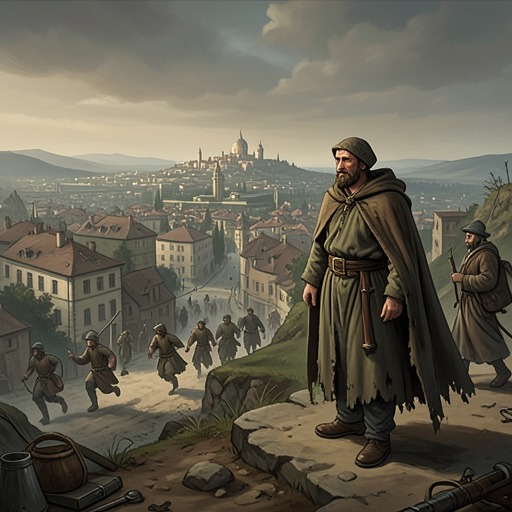
The Last BattleTirian is the last King of Narnia, a young ruler whose reign is tested by treachery and ends with the destruction of the world he has served. His decisive significance lies not in preserving Narnia by force, but in standing firm when its familiar order collapses: he acknowledges his own dishonour, calls for help beyond his world, resists the falsehood imposed on his people, and finally enters a reality larger than the kingdom he has lost.
Identity and Background
About three weeks after the story’s opening events, Tirian is between twenty and twenty-five years old. He has broad shoulders and strong, muscular limbs, but a scanty beard; his blue eyes and fearless, honest face mark him as a young king already shaped by responsibility. He is staying at a small, low thatched hunting lodge near the eastern end of Lantern Waste, above the meeting of two rivers. In the pleasant spring weather he often lives there for ten days or so, preferring its simplicity and ease to the state and pomp of Cair Paravel.
His quiet retreat is also a place of intimate companionship. Only Jewel the Unicorn is with him on the spring morning when the crisis begins. The two love one another like brothers, and each has saved the other’s life in war. As they sit together, Jewel polishes his blue horn against his pale flank; Tirian, preoccupied by news, cannot settle to work or sport and wonders whether they will hear more that day. The image of an unhurried king beside his closest friend establishes what the coming violence will interrupt.
The First Crisis: Anger, Violence, and Shame
Tirian’s first response to the attack on Lantern Waste is immediate and martial. A beech-tree Dryad arrives to seek justice, reporting that forty great trunks of her brothers and sisters have already been felled. At her appeal, Tirian leaps to his feet, draws his sword, and demands to know who dares to cut down the talking trees. As she shudders and falls, she vanishes: her tree, miles away, has been cut down. Her death turns the distant destruction of the forest into a personal loss before the King’s eyes.
Grief and anger propel Tirian and Jewel into an attack on the enemy, but once the immediate violence is over, Tirian judges their conduct rather than excusing it. He tells Jewel that they have done a dreadful deed: they attacked by surprise, without first challenging their opponents, while those opponents were unarmed. He calls himself and Jewel murderers and says he is dishonoured forever. Jewel lowers his head in shame as well. Tirian’s willingness to name his own wrongdoing complicates the image of the fearless warrior: honour is not merely a claim he makes against his enemies, but a standard by which he condemns himself.
That moral reckoning sharpens the crisis of belief. The Horse and the Rat have both said that Aslan is present and has ordered events, but Tirian cannot reconcile the claim with what he has seen. His uncertainty matters because the enemy’s power depends on attaching Aslan’s authority to acts of destruction and control. Tirian’s response is not to accept the claim without question; he must act amid a conflict in which belief itself has been manipulated.
Resistance and the Call Beyond Narnia
When Narnia’s suffering continues and the night gives no outward sign of change, Tirian asks not for his own rescue but for Narnia’s. Though there is no alteration in the darkness, cold, or stillness, he begins to feel a faint hope and greater strength. He calls on Aslan, first asking for helpers from beyond the world and then, hardly knowing that he is doing so, raises his voice to summon the Friends of Narnia. He identifies himself as King of Narnia, Lord of Cair Paravel, and Emperor of the Lone Islands. The summons turns his isolation into an appeal across worlds, and immediately afterward he enters a dreamlike experience more vivid than any he has known.
Later, when Puzzle’s disguise is exposed and the deception breaks in front of the Dwarfs, Tirian makes his identity part of the challenge. Drawing his sword, he names his words as his password: “The light is dawning, the lie broken. Now guard thee, miscreant, for I am Tirian of Narnia.” He attacks the chief Calormene soldier; Eustace engages another, while the Dwarfs dispose of the remaining two. Tirian’s declaration does more than announce who he is: it makes the breaking of the lie the moment for open resistance, although the Dwarfs’ role in the fight does not mean they will later accept his attempt to free them.
At the Stable, Tirian again places his body between the threatened Narnians and their oppressors. He steps out with six companions, four in shining mail, raises his sword in the firelight, and calls on the people to stand beside him. He declares that he is acting in Aslan’s name, denounces Tash as a foul fiend, identifies the Ape as a traitor, and says the Calormenes deserve death. His appeal asks the Narnians not to wait passively while new masters kill them one by one. Here the king’s public courage is inseparable from his insistence that Narnia’s people still have a choice to resist.
The End of Narnia and the King’s Grief
After the world’s destruction has begun, Aslan appears to Tirian and the others. Tirian turns last, afraid, and sees the golden Lion he has longed for. He approaches trembling, throws himself at Aslan’s feet, and is kissed by him. Aslan calls him the last of the Kings of Narnia who stood firm at the darkest hour. The recognition confirms that Tirian’s final distinction is endurance: he has not been able to stop Narnia’s end, but he has remained faithful through the darkest part of its collapse.
The end comes on a cosmic scale. At Aslan’s call, the stars fall from the sky and are revealed as people whom he is calling home. Creatures then come before Aslan; those who meet his gaze with fear and hatred turn away, and Talking Beasts among them become ordinary animals. Others, though sometimes frightened, love Aslan and enter through the Door. Tirian’s lost companions and allies—including Jewel, Roonwit, Farsight, Poggin, the good Boar and Bear, the Dogs, and the Horses—are among the happy creatures who gather again with him. The judgment separates those who turn away from those who enter, while reunion restores to Tirian companions he had thought dead.
The old world’s ending is completed in a measured sequence. The waters rise until they meet the sky and reach the Doorway without crossing its threshold. Digory and Polly recognize that the greatly enlarged, dark red sun is dying; the moon draws toward it until the two become one burning mass. Aslan then says, “Now make an end.” The Time-giant takes the sun and squeezes it, and total darkness follows. Tirian has not escaped the destruction of Narnia; he stands among its witnesses, at the boundary between the world he knew and what comes after.
He refuses to treat that loss as an occasion for easy consolation. As the company walks away from the Door, Tirian says that the ladies are right to weep, and that he weeps too. He has seen his mother’s death, but Narnia is the only world he has known; in his view, failing to mourn it would be discourteous, not virtuous. The sorrow is concrete and communal: the group leaves the Dwarfs still trapped in their imaginary Stable and speaks instead of Narnia’s old wars, periods of peace, ancient Kings, and glories. Tirian’s mourning gives the lost kingdom its due before the story moves beyond it.
Renewal, Memory, and Narrative Significance
Tirian’s movement into the new country preserves his identity while changing his relation to what has been lost. When the company debates the landscape beyond the Door, he asks whether it is Aslan’s country. Jill distinguishes it from the country she has seen beyond the eastern end of the world, while Edmund recognizes features resembling the mountains west of Narnia’s Waterfall. The exchange places Tirian’s question within a world that exceeds the categories available to him: this country is not simply the familiar Narnia restored, nor simply a place he has already visited.
At the Waterfall, Jewel reaches the foot first, and Tirian follows just behind him. Jewel moves up the face of the water, dividing it with his horn, while Tirian ascends as if swimming straight up a wall. Their shared passage echoes their brother-like bond, now carried into a landscape where what would be impossible in the old world becomes possible. Tirian reaches the river above the fall with the others, dripping but happy. The ascent does not erase the earlier destruction; it gives his journey a direction beyond it.
A further reunion makes the movement personal. Tirian recognizes Reepicheep as one of Narnia’s great heroes, then feels strong arms around him and hears a familiar voice. It is his father, King Erlian, not as Tirian last saw him pale and wounded, nor as the grey-headed warrior of later memory, but young and merry as Tirian remembers from early childhood. The memory of playing with him in the Cair Paravel castle garden before bedtime returns along with the smell of the bread and milk he had eaten for supper. The passage from loss to reunion is thus carried by precise childhood recollection, not by a general claim that the past has been restored unchanged.
Tirian’s final arrival belongs to a larger revelation. Aslan tells the children that a real railway accident has occurred and that they, along with their parents, are dead; the old life has ended, but this is not the end of their story. Aslan ceases to look like a lion, and the narrator describes the events that follow as too great and beautiful to write. For Tirian, the book’s ending frames the destruction he mourned not as a return to the same political world but as an entrance into the beginning of a greater story. His arc therefore holds grief and hope together: Narnia deserves mourning because it was truly his home, and its end does not exhaust the reality into which he is received.